
Artificial intelligence entered the daily routine of office workers in the form of ChatGPT in 2023. While early adopters adopted this chatbot in Q1 2023, software engineers began using it as soon as OpenAI made it available (Nov 30, 2022). This day can be considered the beginning of the generative artificial intelligence (genAI) revolution.
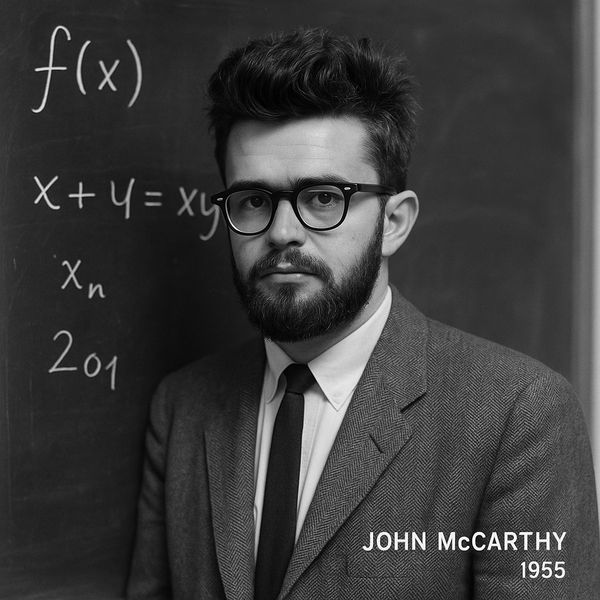
The term of artificial intelligence was coined by John McCarthy and first introduced in a proposal for a Dartmouth summer research project 31. August 1955, that is 70 years ago.
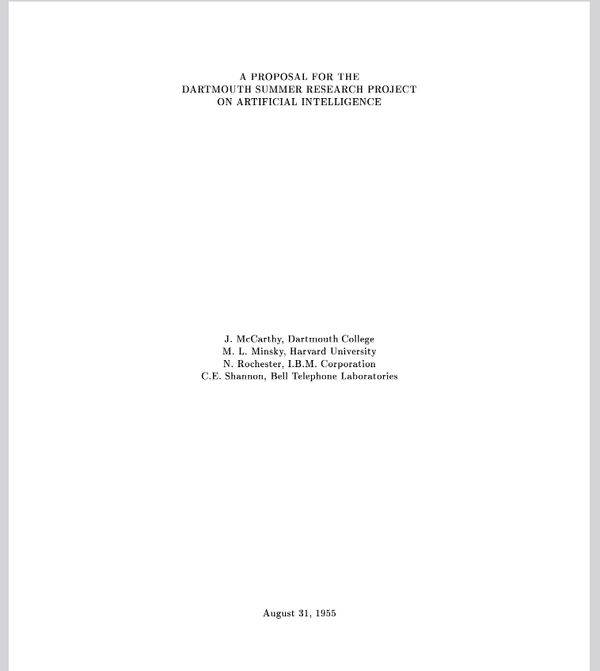
The Dartmouth Summer Research Project
The Dartmouth Summer Research Project on Artificial Intelligence, held in 1956, is widely considered the founding event of artificial intelligence as a field and has been called “the Constitutional Convention of AI.”
The workshop was based on the revolutionary conjecture that “every aspect of learning or any other feature of intelligence can in principle be so precisely described that a machine can be made to simulate it.” Furthermore the proposal promised that …
“An attempt will be made to find how to make machines use language, form abstractions and concepts, solve
kinds of problems now reserved for humans, and improve themselves. We think that a significant advance can be made in one or more of these problems if a carefully selected group of scientists work on it together for a summer.”
The project lasted approximately six to eight weeks during the summer of 1956 and was essentially an extended brainstorming session, with only three participants staying for the full duration: Ray Solomonoff, Marvin Minsky, and John McCarthy.
McCarthy chose the name “Artificial Intelligence” partly for its neutrality, avoiding associations with narrow automata theory and cybernetics, which was heavily focused on analog feedback.
The original proposal outlined ambitious goals including making machines use language, form abstractions and concepts, solve problems reserved for humans, and improve themselves.

In his proposal, McCarthy stated some aspects of the artificial intelligence problem:
Aspect #2. How Can a Computer be Programmed to Use a Language
McCarthy et al.: “A large part of human thought consists of manipulating words according to rules of reasoning and rules of conjecture. From this point of view, forming a generalization consists of admitting a new word and some rules whereby sentences containing it imply and are implied by others.”
Current state: Largely Achieved. Modern LLMs like GPT-4, Claude, and others excel at manipulating words according to complex reasoning patterns. They demonstrate sophisticated understanding of grammar, semantics, and context, forming generalizations across vast linguistic domains. They can learn new concepts and apply rules whereby sentences containing them imply others. However, their “understanding” remains debated—they manipulate linguistic patterns extraordinarily well, but whether this constitutes true comprehension or sophisticated pattern matching remains an open question. The practical goal of language use has been dramatically surpassed, even if the deeper philosophical questions about machine understanding persist.
Aspect #3. Neuron Nets
McCarthy et al.: “How can a set of (hypothetical) neurons be arranged so as to form concepts.“
Current state: Significantly Achieved. Modern neural networks, particularly transformer architectures and deep learning systems, demonstrate remarkable concept formation abilities. These networks arrange artificial neurons in layers that progressively build abstract representations from raw data—recognizing objects in images, understanding semantic relationships in text, and forming complex conceptual hierarchies. Convolutional neural networks excel at visual concept formation, while language models develop rich representations of abstract concepts like justice, creativity, or causation. While these aren’t biological neurons, the computational principle of distributed processing creating emergent concepts has been validated and exceeded McCarthy’s expectations.
Aspect #6. Abstractions
McCarthy et al.: “A number of types of “abstraction” can be distinctly defined and several others less distinctly. A direct attempt to classify these and to describe machine methods of forming abstractions from sensory and other data would seem worthwhile.”
Current state: Remarkably Achieved. Modern AI systems excel at forming multiple types of abstractions from sensory data. Computer vision models extract hierarchical abstractions from pixels to edges to objects to scenes. Language models form semantic abstractions from words to concepts to complex reasoning. Multimodal AI systems like GPT-4V combine visual and textual abstractions. Machine learning techniques like representation learning, feature extraction, and dimensionality reduction have created sophisticated methods for abstraction that often surpass human capabilities in specific domains. The classification and systematic description of these abstraction methods has become a mature field of study.
Aspect #7. Randomness and Creativity
McCarthy et al.: A fairly attractive and yet clearly incomplete conjecture is that the difference between creative thinking and unimaginative competent thinking lies in the injection of a some randomness. The randomness must be guided by intuition to be efficient.”
Current state: Partially Achieved. Modern AI incorporates randomness in sophisticated ways—temperature settings in language generation, dropout in training, and stochastic sampling methods. AI systems demonstrate remarkable creativity in art, writing, music, and problem-solving, often producing novel combinations and ideas. However, the “guided by intuition” aspect remains elusive. While AI can be creative, it lacks genuine intuition in the human sense. The randomness is guided by learned patterns and statistical relationships rather than true intuitive understanding. Modern AI achieves impressive creative outputs but through different mechanisms than McCarthy likely envisioned—more statistical than intuitive.
But now AI is more than a science and a technology. It has penetrated into social and economic sphere. Today’s generative AI revolution brings new capabilities every 6 months. Businesses and workers are testing new ways of operation, which has already shown that work will never be the same again.
Geoffrey Hinton compared AI to inventing the wheel
Artificial General Intelligence, if attained, will be the greatest invention in history, far more transformative than the printing press or the wheel.
Geoffrey Hinton, the “godfather of artificial intelligence,” has compared the AGI revolution to the invention of the wheel, illustrating the profound impact this technology could have on humanity.
Unlike the wheel, which revolutionized transportation and industry but remained fundamentally a mechanical tool, AI represents something unprecedented: an intelligent entity capable of continuous learning and improvement that will lead to sustained progress in all fields of knowledge and endeavors.
While both the wheel and AI are transformational technologies with profound societal impact, AI’s versatility spans across virtual assistants, recommendation engines, autonomous vehicles, and countless applications, promising to reshape modern society in ways the wheel never could. The wheel enabled faster transportation and trade; AI enables faster thinking, decision-making, and problem-solving across every domain of human activity.
Sundar Pichai considered AI more important than fire or electricity
Google CEO Sundar Pichai has boldly declared that “AI is one of the most important things humanity is working on. It is more profound than, I dunno, electricity or fire.” According to Pichai, AI represents “the most profound technology humanity is working on—more profound than fire or electricity or anything that we’ve done in the past,” because “it gets to the essence of what intelligence is, what humanity is.”
Historically, general purpose technologies like fire drove major tipping points in human development—from hunter-gatherer to agrarian, and agrarian to industrial eras.
Fire enabled cooking, warmth, protection, and tool-making, fundamentally changing human evolution and survival. However, AI combines both knowledge growth and platform technology in a way that prior transformative inventions did not, potentially representing the pinnacle of knowledge attainment. While fire “kills people too,” as Pichai notes, “we have learned to harness fire for the benefits of humanity but we had to overcome its downsides too.”
References
Dartmouth Summer Research Project: The Birth of Artificial Intelligence – History of Data Science
Dartmouth workshop – Wikipedia
Artificial General Intelligence, If Attained, Will Be the Greatest Invention of All Time – EDRM
Artificial General Intelligence, If Attained, Will Be the Greatest Invention of All Time – EDRM
Clifford, 2018, Google CEO: AI is more important than fire, electricity
Surprising Similarities Between Artificial Intelligence and the Wheel
Moore, 2006, The Dartmouth College Artificial Intelligence Conference: The Next Fifty Years